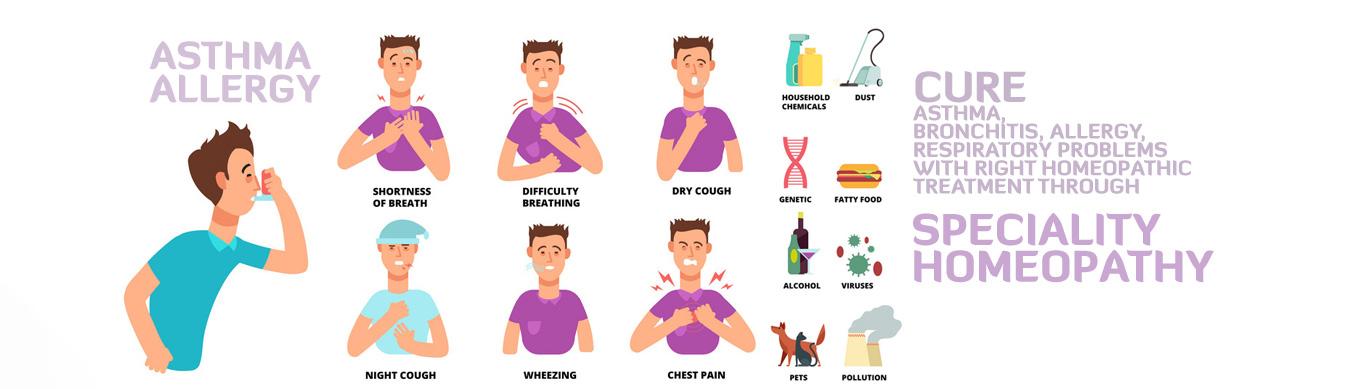
Asthma & Allergy
Everyone needs to breathe air into and out of the lungs. When we breathe inwards through our nose or mouth the air is taken into our windpipe (trachea). When it reaches our chest area the windpipe branches into two smaller tubes (Bronchi) which lead to each of our lungs.
Inside our lungs the bronchi branch into even smaller tubes (bronchioles), finally ending in tiny air sacs called alveoli.
When all these tubes are functioning normally air is taken in and out of our lungs without us being conscious of it.
During asthma attack there is narrowing of the airways which is temporary this is due to the unusual sensitivity to the irritants present in the environment.
Due to series of reactions that take place there is irritation of the air tubes .There is bronchospasm due to contraction of the muscles in the wall of the bronchioles and this causes narrowing of the airways. The lining of the tubes (sub mucosa) becomes inflamed excess of mucus is produced which leads to coughing and production of sputum.
All these three condition reduces the air passage and due to this breathing the air in and out of the lungs becomes difficult.
As exhaling is harder to do then breathing the air in some of the air is trapped in the alveoli .The narrowing of the air tubes causes a wheeze which is heard during breathing.
Chronic lung disease characterised by difficulty in breathing, coughing, wheezing from chest ( whistling like sound during breathing ) feeling of tightness in chest.
Causes
Upper Respiratory tract Infection
Stress & Anxiety aggravates the symptoms
Allergy to Pollen, Dust, Smoke, Animal Dander, Mold or other irritants.
Excessive Exercise
Exposure to cold wave or Draft of cold air
Eating habits or Allergic to certain food
Medicines Perfumes and Room air fresheners
Change of weather
Children with a strong Family history of Asthma
Suppression of Skin Disease or History of skin disease treated with modern medicine
Role Of Homeopathic medicine in treatment of Asthma
Constitutional Homeopathic medicine helps to overcome Asthma.
Intensity and periodicity of attack decreases as homeopathic medicine starts its effect.
Children take 4 to 6 month to get cure from symptoms, adults require 9 month to 12 month and If Asthma Alternate with skin disease than it will take long time maximum up to 18 month
More Information about Asthma
What is Asthmatic Bronchitis ? Treatment Cure with Homeopathic Medicine
Classification Of Asthma
- Extrinsic Asthma
- Intrinsic Asthma
Extrinsic asthma is that which is triggered by known or unknown external allergens. Substances which cause allergies are known a s allergens. Intrinsic asthma refers to those cases where there is no allergen present and the skin tests remain negative.
Precipitating factors
- Inhalant allergens means those allergens which are inhaled by the person through the atmosphere. Few of the common allergens are pollens from the plants, weeds, trees, house dust, mould which is found on vegetations or also in the soil ,and animal dander the hair and feathers from animals. Some of the artificial flavors in food are also known to trigger of an attack of asthma.
- Food allergens some of the food items like Milk, Chocolates, Fish, Shell fish, Strawberries, Ice creams, Cold drinks are known to trigger an attack but not in all cases. It has to be noted which food leads to an attack so in the future the person can avoid that food substance to prevent the attack.
- Drugs: some of the drugs are known to trigger of an attack so these drugs should be avoided.
- Exercise It is important for everyone especially to asthmatics, but the type of exercise has to be selected. It should be kept in mind not to get into long periods of intense exercise as it can trigger an attack of asthma and this can lead to a cycle of the exercise induced asthma. Exercise that repeatedly provokes an attack should be avoided .The proper exercise should be discussed with the doctor and a warm up exercise is a must be doing the actual exercise.
- Infections in children who are known to have allergic tendencies can suffer from an attack due to infection.
- Psycho logic stress due to over excitement in children or due to excess worry and stress in adults an attack can be precipitated.
- Environmental causes
Some people show symptoms when exposed to environmental conditions containing increased concentration of airborne pollutants and antigens. Polluted air can alter the threshold of the irritant receptors in the airways of latent asthmatic so as to create a response to other less noxious stimuli. - Occupational factors
This variety has various subtypes such as meat wrappers asthma; baker’s asthma; and wood workers’ asthma. These are the faculties in which reversible airway disease can be found or develops with time.
The Asthma Attack
- In the initial stage there is an asthmatic aura sometimes sneezing, flatulence, Drowsiness or restlessness irritability will be present. There can be a dry cough along with wheezing breathlessness these are some of the symptoms before the actual asthmatic attack.
- Sense of oppression in the chest suddenly in the middle of the night is experienced. There is a sense of suffocation and the patient leans forward fighting for his breath; or he may go to the open window to relieve the suffocation.
- Anxiety, perspiration, cold extremities and cyanosis might be present.
- Wheezing is present and can be heard from a distant.
- In severe airways obstruction airflow maybe so reduced that the chest is almost silent on auscultation.
- Inspiration is short and high pitched while the expiration is prolonged. On auscultation there are plenty of rhonchi and rales heard.
- Termination is spontaneous or due to medication. As the bronchial spasm is less the patient is able to breathe and he can also cough which brings out viscid sputum which relieves him.
- The duration of the attack varies from a few minutes to hours. The attacks can last for many hours in paroxysms this state is known as Status asthmaticus. In this state the patient has to be admitted to the hospital so that he can be supplied with oxygen and other auxiliary methods of treatment
Complications
- Respiratory fatigue
- Pneumothorax
- Death
- Side effects of the medication used
- Pneumomedistinum
- Atelectasis
Prevention
Asthma symptoms can be substantially reduced by avoiding known allergens and irritants. If someone with asthma is sensitive to dust mites, encasing mattresses and pillows in allergen-impermeable covers, removing carpets from bedrooms and by vacuuming regularly can reduce the frequency of the attacks. Exposure to dust mites and moles can be reduced by lowering indoor humidity. If a person is allergic to an animal that cannot be removed from the home, the animal should be kept out of the patient’s bedroom. Filtering material can be placed over the heating outlets to trap animal dander. Exposure to cigarette smoke, air pollution, industrial dusts, and irritating fumes should also be avoided.
Prognosis
Death from asthma is uncommon. Between 50 to 80 % of all patients can expect to have a reasonable good prognosis, especially those who develop asthma in childhood. According to few studies, spontaneous remissions occur in approximately 10% of those who develop the disease as adults and 20% or so can be expected to improve with less frequent and less severe attacks as they grow up.
Treatment
It is possible to cure Asthma with right Homoeopathic Treatment. Elimination of the causative from the environment of an asthmatic is the best means in treating asthma. Treatment is aimed at a preventive mode like avoiding known allergens and respiratory irritants. Symptoms and airway inflammation are controlled through medication. Common allergens include: pet dander, dust mites, cockroach allergens, molds, and pollens. Common respiratory irritants include: tobacco smoke, pollution, and fumes from burning wood or gas. Allergy testing may also be helpful in identifying allergens in patients with persistent asthma.
The two basic kinds of evaluation factors before the treatment of asthma are:
A Peak flow meter
A simple device to measure lung volume can be used at home. If you are not monitoring asthma on a regular basis, an attack can take you by surprise. Peak flow measurements help to show when medication is needed. Peak flow values of 50-80% indicate a moderate asthma attack, while values below 50% indicate a severe attack.
Emotion
Psychological factors can play a part aggravating or abating attacks of asthma. The stress caused by illness can often be helped by joining a support group, where members share common experiences and problems.
Expectation
Though symptoms sometimes decrease over time, there is a cure for asthma. With proper precautions, self-management and medical treatment, most people with asthma can lead normal lives.
Opiates, Sedatives and Tranquilizers
Should be absolutely avoided in the acutely ill asthmatic because the risk of depressing alveolar ventilation is great and this can lead to respiratory arrest. When administered to susceptible asthmatics, mucolytic agents may actually produce bronchospasm. The use of IV fluids in acute asthma has also been advocated.
Our Asthma & Allergy Treatments
Care for Autism – Expert Support & Guidance
Providing safe, natural, and specialized treatments for autism, neurological disorders, and overall wellness.

Get in touch